
Let’s clear something up right away.
Amazon’s search algorithm isn’t a single formula. It’s not a secret switch. And it’s definitely not something you “crack” once and forget.
What Amazon actually runs is a multi-layered prediction system that decides, in a fraction of a second, which product is most likely to satisfy the shopper standing on the other side of the screen.
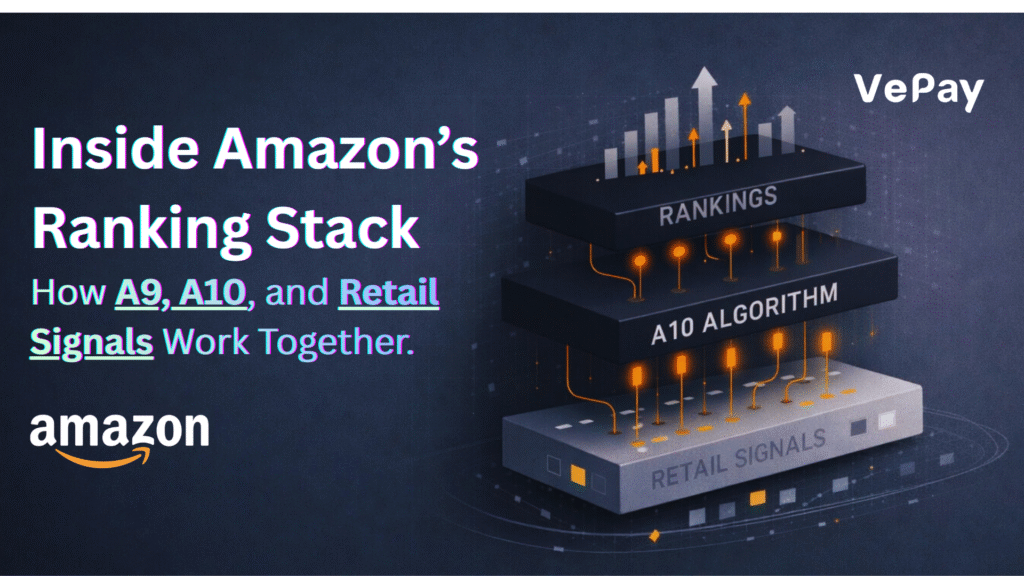
Early Amazon sellers called this system A9. Today, many refer to its evolved version as A10. Amazon itself never officially renamed anything but the behavior clearly changed.
If you’re an eCommerce seller trying to scale on Amazon, here’s the reality you need to understand:
Amazon doesn’t rank products. It ranks outcomes.
And those outcomes are driven by two forces that never change:
- Relevance — does this product match what the shopper asked for?
- Performance — when shown, does this product actually sell?
Everything else feeds into those two ideas.
How Amazon Thinks (in 200–300 milliseconds)
When a shopper types a keyword into Amazon, the system doesn’t “search” the way Google does.
Instead, Amazon runs a rapid-fire evaluation of every viable product against that query using hundreds of signals in roughly 200–300 milliseconds.
The goal isn’t to show the best product.
The goal is to show the product most likely to result in a successful purchase.
That’s why Amazon’s ranking engine behaves more like a sales prediction model than a search engine.
At the highest level, Amazon blends two dimensions:
1. Relevance: “Does this listing match the search?”
Amazon scans:
- Title
- Bullet points
- Description
- Backend search terms
This is where keyword placement still matters. Front-loading your primary keyword in the title and supporting it with secondary terms in bullets helps Amazon understand what your product is about.
But relevance alone doesn’t win rankings anymore.
2. Performance: “When shown, does this product satisfy shoppers?”
Amazon tracks what happens after your product appears:
- Do shoppers click it? (CTR)
- Do they buy it? (Conversion Rate)
- Do they return it?
- Do they complain?
- Do they reorder?
A listing that technically matches a keyword but doesn’t convert is quietly buried.
A listing that converts well keeps climbing.
In simple terms:
If your product doesn’t sell, Amazon stops showing it.
A9 Explained: Where Rankings Originally Came From
In its earlier form, Amazon’s ranking logic (what sellers called A9) was fairly direct:
Keyword match + Sales performance = Rank
SellerLabs summarized it well: A9 heavily weighted sales velocity, supported by keyword relevance, CTR, conversion rate, pricing, and even ad-driven impressions.
Amazon rewarded anything that turned a search into a purchase.
Let’s break down the signals that still matter today.
The Core Ranking Signals You Can Actually Control
1. Keywords & Relevance (Getting Indexed Correctly)
Amazon still needs to understand what you’re selling.
- Title → primary relevance
- Bullet points → secondary relevance
- Backend search terms → synonyms, variations, edge cases
Keyword stuffing doesn’t help. It hurts readability, lowers conversion, and can backfire.
Your goal is clarity, not density.
If Amazon can’t confidently match your product to a query, you never enter the race.
2. Click-Through Rate (CTR): The First Real Test
CTR is Amazon’s early warning system.
If your product shows up and nobody clicks it, Amazon assumes:
“This wasn’t a good result.”
If shoppers do click, Amazon learns:
“This product looks relevant.”
Here’s why CTR matters so much:
- The #1 result gets ~30–35% of clicks
- The top 3 results capture ~64% of all clicks
That means tiny improvements in CTR can completely reshuffle rankings.
As a rough benchmark:
- Below 0.5% CTR → weak
- 1–3% CTR → solid
- Above 2% organically → very strong
If your listing isn’t getting clicks, Amazon won’t give it more chances.
3. Conversion Rate (CR): Where Rankings Are Won or Lost
Once a shopper clicks, Amazon watches closely.
Did they buy?
Conversion rate is arguably the most important ranking signal.
Why?
Because Amazon’s entire business model depends on completed transactions.
As a rule of thumb:
- 15%+ conversion rate → usually dominates page one
- Under 8% → struggles to hold rank
A mismatch between:
- Price
- Reviews
- Images
- Expectations
…will crush conversion — and when conversion drops, ranking follows.
Amazon doesn’t punish bad listings.
It simply stops promoting them.
4. Price & Promotions: Stability Beats Aggression
Price influences both CTR and conversion.
Data shows:
- Products priced within ±10% of the category median perform best
- Being 30%+ higher than competitors can cut CTR by 40–50%
What surprises many sellers:
Constant discounting hurts you.
Listings with frequent price changes experience:
- Higher ranking volatility
- Less algorithmic trust
Amazon prefers predictable sellers with stable pricing and occasional, intentional promotions.
5. Fulfillment, Buy Box & Inventory: The Silent Killers
Two ranking killers you can’t afford to ignore:
Buy Box
If you lose the Buy Box, Amazon effectively removes you from search visibility.
Listings with:
- 90%+ Buy Box ownership see 60–80% better rankings
This is why seller metrics matter more today than price alone.
Inventory Health
Even short stockouts are brutal:
- 7 days out of stock → ranking drop of 30–50%
- Recovery can take weeks
If Amazon can’t sell your product today, it won’t rank it tomorrow.
Inventory planning is a ranking strategy, not just an ops task.
6. Reviews & Customer Feedback
Amazon tracks satisfaction obsessively.
- 4.7★ and above → ranking lift
- Below 4.3★ → suppression
- Returns, A-to-Z claims, complaints → all quietly hurt visibility
More positive reviews = more trust = higher conversion = higher rank.
Why A10 Changed the Game
A10 isn’t a new algorithm.
It’s a shift in priorities.
Amazon started caring less about short-term sales spikes and more about long-term customer experience.
Here’s what changed.
What A10 Rewards Today
External Traffic (Yes, Amazon Wants It)
Amazon now rewards sellers who bring customers from outside.
Traffic from:
- Social media
- Influencers
- Content sites
…acts like a quality signal.
Why?
Because it proves demand exists beyond Amazon ads.
Roughly:
- 1,000 external visits/month ≈ 5–7 organic sales in ranking value
That’s massive.
Organic Sales > Ad Sales
Ads still matter, but organic demand matters more.
A product that sells naturally often outranks one pushed only by PPC.
Amazon prefers listings that:
- Earn clicks naturally
- Convert without being forced
Paid traffic helps, but it no longer carries the same ranking weight alone.
Seller Authority & Account Health
Amazon increasingly trusts proven sellers.
Metrics that matter:
- Order Defect Rate (ODR)
- Feedback score
- Cancellation rate
- Response time
Today, the Buy Box often goes to:
The most reliable seller, not the cheapest one.
Engagement Signals & Content Depth
Amazon watches how shoppers behave:
- Time on page
- Scroll depth
- Image interaction
- FAQ views
- Add-to-Cart behavior
Listings with:
- A+ Content
- Videos
- Clear FAQs
…convert better and Amazon notices.
Smarter, Context-Driven Search
Amazon’s search is becoming more intent-based:
- Synonyms
- Phrase meaning
- Personalization
This rewards natural, readable titles, not keyword-stuffed nonsense.
The Big Myth: “One Algorithm to Hack”
There is no single A9 formula.
No A10 trick.
No permanent ranking hack.
Amazon runs:
- Relevance engines
- Performance evaluators
- Competitive comparison models
- Personalization layers
All updating constantly.
That’s why rankings shift.
That’s why competitors matter.
That’s why shortcuts fail.
A Simple Example: Why One Product Wins
Search: “wireless noise cancelling earbuds”
Product A
- Clear title
- Prime / FBA
- 4.8★ reviews
- Competitive price
- Strong inventory
- External traffic
Product B
- Average title
- FBM, slower shipping
- 4.2★ reviews
- Higher price
- Stockouts
Even with similar keywords, Product A wins every time.
Because Amazon predicts:
“This customer will be happier here.”
Final Takeaway: Optimize Like Amazon Thinks
Amazon doesn’t reward clever hacks.
It rewards predictable satisfaction.
To win rankings:
- Get relevance right
- Maximize CTR
- Protect conversion
- Ship fast
- Stay in stock
- Keep seller metrics clean
- Think long-term
If something isn’t ranking, ask:
- Are people clicking?
- Are they converting?
- Are they happy after buying?
That’s how Amazon thinks.
And when you align with that mindset, rankings stop feeling random and start becoming predictable.