
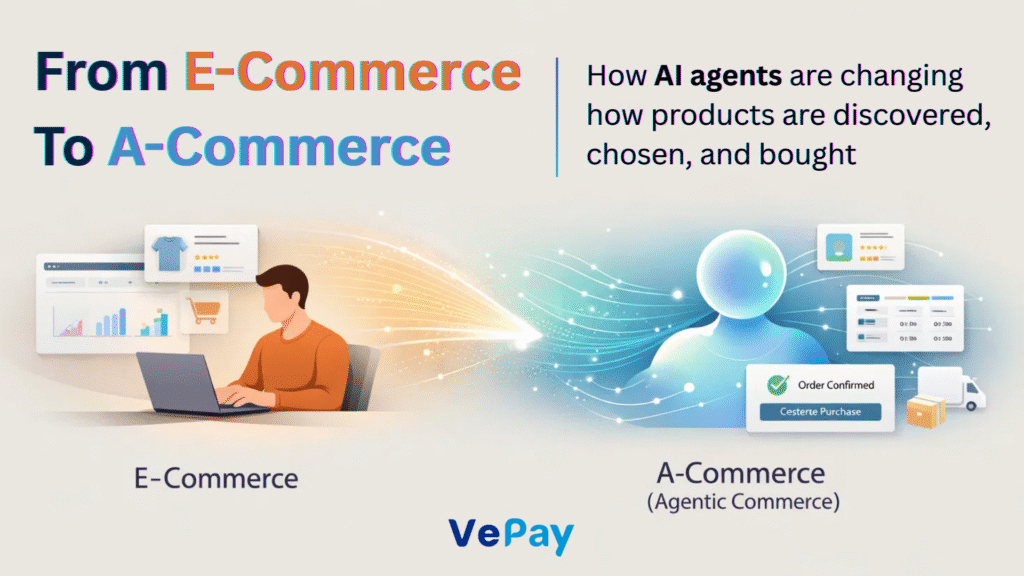
Imagine telling an AI agent, “Find me a gift for my spouse and check out” and it does it. That’s the promise of Agentic Commerce (A-Commerce): shopping powered by autonomous AI assistants that handle everything from discovery to checkout. In this new paradigm, consumers delegate tasks to “digital personal shoppers,” not just click around on a website. As McKinsey puts it, agentic commerce means “shopping powered by intelligent AI agents capable of anticipating, personalizing, and automating every step of the process to create frictionless, proactive experiences.”. This shift goes beyond simple chatbots or recommendations – AI agents will act on our behalf, closing the loop from intent to purchase. With major retailers already testing AI shopping assistants, the e-commerce landscape is poised for a revolution.
What Is A-Commerce (Agentic Commerce)?
A-Commerce is essentially eCommerce on autopilot: an AI agent becomes a full-stack shopper for the user. You might just say, “Reorder my running shoes when they go on sale,” and the agent handles it no human clicks needed. These AI agents interpret messy, natural requests, search thousands of products, compare prices and reviews, then buy the best option, using your stored payment info – all without you lifting a finger. In other words, the agent “closes the loop” on shopping decisions. This is a leap from traditional e-commerce (where the user clicks every step) to fully autonomous shopping.
This new era has a name: A-Commerce (short for Agentic Commerce). It’s being hailed as the “third wave” of retail after Web shopping and mobile shopping. In practical terms, it means AI assistants will handle multi-step tasks (like assembling a birthday gift package or restocking supplies) from soup to nuts. Unlike legacy chatbots that wait for questions, these agents are proactive and goal-driven: they know your taste, track inventory, negotiate with merchant bots, and handle checkout on your behalf. The result is hyper-personalized, on-demand shopping with zero friction for the consumer.
A-Commerce in Action: Examples from Amazon
Big players are already pushing into A-Commerce. Amazon, for example, has rolled out several AI shopping assistants:
- Rufus (AI Shopping Assistant): Introduced in 2023, Rufus is a generative AI chat assistant in the Amazon app and website that answers questions about products and categories. Customers have “already asked Rufus tens of millions of questions,” using it to compare features and get recommendations. While Rufus itself still waits for user prompts, it illustrates how AI can enrich product search and discovery.
- Buy for Me / Shop Direct: In 2025, Amazon began piloting Buy for Me, an agentic feature that lets shoppers purchase items from other brand websites within the Amazon app. When a user taps “Buy for Me,” Amazon’s AI agent completes the checkout using the customer’s saved payment and shipping info. In effect, Amazon’s agent can grab products outside its marketplace on your behalf. During tests, Amazon surfaced third-party brands directly in its search results, and the agented checkout handled payment seamlessly. Notably, Amazon says it takes no cut of these sales and hands order follow-up to the brand. This reflects the promise of A-Commerce: AI agents extending the retailer’s reach into otherwise unreachable products.
However, this innovation hasn’t been frictionless. A recent report noted that Amazon’s “Shop Direct” browsing and “Buy for Me” ordering sparked backlash from smaller brands. By web-scraping brand sites and listing items on Amazon without permission, the AI agents inadvertently “surprised” sellers who hadn’t opted in. Over 500,000 products are now purchasable via Buy for Me – but some brands felt “exploited” that their items appeared on Amazon at all. The takeaway for sellers is clear: as AI agents proliferate, control and consent become critical issues.
How AI Shopping Agents Work
To understand A-Commerce, picture a coalition of mini-AIs collaborating. A personal shopping agent will: interpret your natural-language intent, query multiple online catalogs, analyze prices, reviews, and stock, and then carry out the order. In effect, it’s like having a team of specialists at work. For example, one “expert” agent might focus on price comparison, another on user reviews, and another on checkout. They communicate via emerging protocols (like Google’s Agent-to-Agent and MCP standards) to coordinate complex tasks.
Concretely, an AI agent can navigate multiple marketplaces in seconds and make split-second judgments on price, quality, availability, or brand preferences. Large Language Models (LLMs) enable it to parse a messy request (e.g. “gift basket under $100 with wine and chocolate”), break it into steps, search dozens of sites, filter options, and even ask clarifying questions if needed. Once the agent has a shortlist, it adds items to cart and checks out using your saved credentials. Importantly, these agents can learn your habits: the more you use them, the better they know your style, budget, and favorite brands.
Here’s a simplified view of the agent’s workflow:
- Interpret Intent: Convert natural request into a clear goal. (LLMs excel at understanding context.)
- Product Discovery: Search across retailer catalogs and even Google-like shopping indexes for matching items.
- Compare & Filter: Evaluate prices, ratings, shipping, and even negotiate with seller agents if needed.
- Selection & Purchase: Add the best product(s) to cart, then complete checkout end-to-end using stored payment info.
- Confirmation & Follow-up: Send you confirmations, track shipment, or ask for feedback if something was off.
Each step blends AI understanding with e-commerce systems. Generative AI makes the agent conversational and flexible, while APIs or advanced data protocols handle the purchasing. In the near future, expect agents that can even multi-task (for example, ordering laundry detergent and booking dry cleaning, handling them as separate transactions).
The Big Picture: Market Adoption and Impact
From a seller’s perspective, the implications are massive. One analyst remarks, “Agentic will be a paradigm shift for e-commerce… [AI agents] could shake up the e-commerce funnel with implications across retailers and digital ad players”. In practice, this means the traditional customer journey (ad → site visit → cart → purchase) could be short-circuited. Brands and retailers must prepare for an era where AI agents, not browsers or apps, may come knocking first.
The growth projections for A-Commerce are staggering. McKinsey estimates that by 2030, agentic commerce could account for up to $1 trillion of U.S. retail sales (and $3–5 trillion globally). Likewise, Morgan Stanley projects AI agents could drive $385 billion in U.S. online sales by 2030. Their survey data suggests that within five years, nearly half of U.S. online shoppers will routinely use AI shopping assistants. In fact, Morgan Stanley finds about 23% of Americans already made an AI-assisted purchase in the past month, and LLM usage among consumers is nearing 50%. PayPal concurs with this trajectory: it predicts that 20–30% of its customers will begin shopping via AI agents within five years.
These forecasts imply that A-Commerce will not only grow but dominate the funnel. Gartner research even suggests AI agents could drive 20% or more of e-commerce traffic within five years. That means a significant share of buying decisions will be agent-mediated, not person-mediated. For example, instead of clicking through an email or search ad, a consumer might simply tell their shopping agent to “buy the black blouse from my previous order” or “reorder dog food when it’s cheap,” and the agent handles the rest.
Optimizing for the Agentic Era: Seller Strategies
With AI agents in charge of much of the buying process, e-commerce sellers must rethink how they present products. In short, treat AI agents like new search engines: optimize your data for them. Here are key strategies:
- Rich, Structured Product Data: Agents consume data, not messy websites. Provide semantic, AI-friendly feeds with detailed attributes (size, color, materials, compatibility, etc.) rather than bare bones SKU info. According to AWS, product catalogs “must evolve beyond basic SKU-level information” into rich, semantic descriptions that AI can interpret. Think taxonomies and relationships (e.g. “this shirt pairs with that jacket”) so agents can make bundles. Use standard schema tags and ontologies that AI protocols recognize. The goal is to make your products discoverable and understandable by a machine.
- Agentic Discoverability: Just like SEO, plan for “A-Commerce Optimization.” Ensure your product feeds, APIs and metadata are accessible to third-party agents. For example, joining standardized agentic protocols (ACP/AP2/MCP) or allowing well-known AI platforms to index your inventory gives agents a direct line to your offerings. As one expert puts it, optimizing for agents means ensuring they get “reliable, standardized data they can act upon.”. (The Mirakl Nexus blog highlights that sellers should normalize categories and fill missing attributes so that agents don’t drop your products.) In practice, this might mean exposing an API or structured feed, using product graphs, or partnering with marketplaces that support agentic transactions.
- Semantic Trust Signals: Since agents will handle payments and personal data, they will favor brands they “trust.” Make sure your listings include verifiable information and clear reviews. Encourage third-party trust seals or structured reputation scores that AI agents can parse. Amazon’s backlash story shows the importance of consent and clarity: agents won’t choose a site if customers have no control. Providing opt-in choices, explicit permissions, and transparent service commitments will build confidence in your brand among both agents and end-users.
- Unified Commerce Infrastructure: Agents will prefer sellers with modern infrastructure. Legacy e-commerce stacks can break agent flows. As AWS notes, current platforms are built for human browsing, not AI integration. It pays to invest in flexible commerce APIs that can respond to agent requests in real time – a sort of “agent protocol” for your store. This includes real-time inventory updates, instant pricing APIs, and streamlined checkout flows. Building or joining an “agent-aware” marketplace (one that implements protocols like Google’s MCP) ensures that your products remain visible in AI-driven searches.
- Emphasize Brand and Value: Agents will often compare products head-on, so competing only on price is risky. Differentiate with brand value, quality guarantees, and post-sale support – things an AI agent can learn from past data and reviews. Offer clear guarantees (e.g. easy returns, lifetime warranty) that the agent can parse as positive signals. Think of it like giving the agent good reasons beyond price to pick your product (speed, quality, unique features).
- Focus on First-Party Data: While agents transact, they also collect data on preferences. Encourage customers to connect their AI assistants to your loyalty or review systems so you retain first-party insights. Since AWS warns that failing to engage directly means losing customer data to intermediaries, find ways for customers to voluntarily share shopping preferences or join your loyalty program—even if the purchase is agent-driven.
- Test AI Tools: Finally, get hands-on with agent platforms. Play with tools like Google’s shopping agents or apps from Shopify, and adjust based on what you learn. Just as early SEO movers gained ground, early agentic commerce adopters will capture market share. For instance, tools like Amazon’s Bedrock AgentCore or Perplexity’s shopping mode let you experiment. Start small (maybe optimize one product category for agent search) and scale from there. The important mindset is to embrace AI as a partner, not a threat.
Challenges and Watchouts
The move to A-Commerce isn’t all upside. Sellers face new headaches:
- Funnel Disruption: With agents buying automatically, you may see less direct traffic. Traditional ads and even SEO might get bypassed. If an agent already “knows” the product is good for the user, it might skip your site entirely. This shifts the marketing funnel from “brand → site visit → checkout” to “agent discovery → checkout.” Sellers must rethink promotions accordingly (e.g. agent-specific deals, API-driven coupons, or incentivizing agents with custom signals).
- Visibility and Control: As the Amazon example shows, your products could end up on new channels without your explicit action. If you’re not part of a given agentic ecosystem, you risk being “invisible” to bots. Worse, a third party could scrape and sell your items (or worse, outdated items) behind your back. One vendor reported getting orders through Amazon’s Buy for Me with no prior listing! Being proactive about partnerships and keeping close tabs on where your catalog appears is now essential.
- Trust & Permission: Customers must authorize agents with access to sensitive info. Some shoppers will hesitate to let a bot use their wallet unless they trust it. Brands can play a role by building transparent agent interfaces – for example, allowing customers to review a cart before agent checkout, or requiring PINs for high-value purchases. Also, be wary of legal/contractual issues: if an agent is transacting on your behalf, clarify who is legally responsible for that sale.
- Data Quality: Any mistakes in your data will be magnified. A small typo or outdated description that humans might overlook can completely throw off an AI. Inaccurate inventory status or confusing variant names can cause an agent to skip your product or even fail an order. Rigorous data hygiene is now table stakes.
- Intermediation Fees (Potentially): Although Amazon currently claims no commission on Buy for Me orders, future agentic marketplaces or providers might charge referral fees or premiums for their “agent-fulfilled” tag. Be prepared for new pricing models that may arise as platforms monetize the agent economy.
Leading the A-Commerce Future
The rise of A-Commerce represents a pivot point: sellers can either resist and get left behind, or adapt and thrive. The key message is: treat AI agents as customers. Build trust, give them clear data, and think long-term about how to be indispensable in an automated shopping ecosystem.
Action Steps: Evaluate how an AI agent would “shop” your site. Audit your product data; enrich it where needed. Integrate a basic agent or chatbot on your site to understand how it queries your catalog. Reach out to major AI platforms (Google, Microsoft, AWS, Shopify) for agentic commerce SDKs or partner programs. Keep an eye on standards like the Agentic Commerce Protocol (ACP) and Model Context Protocol (MCP) adopting these early could be a competitive advantage. Above all, start treating your inventory and customer experience in the structured, machine-readable way that AI demands.
A-Commerce is not a distant fad but already unfolding reality. Forward-looking retailers will lead this change by embracing AI tools, not fear them. By optimizing for agents now improving data quality, enabling seamless APIs, and nurturing trust sellers can ensure they aren’t merely along for the ride, but steering the future of commerce. The era of AI personal shoppers is here. Will your business fill the virtual cart… or be left behind in the digital dust?
Sources: Authoritative industry and news sources inform this analysis, including McKinsey, Morgan Stanley, AWS and Amazon announcements, and credible reporting in retail tech media.