
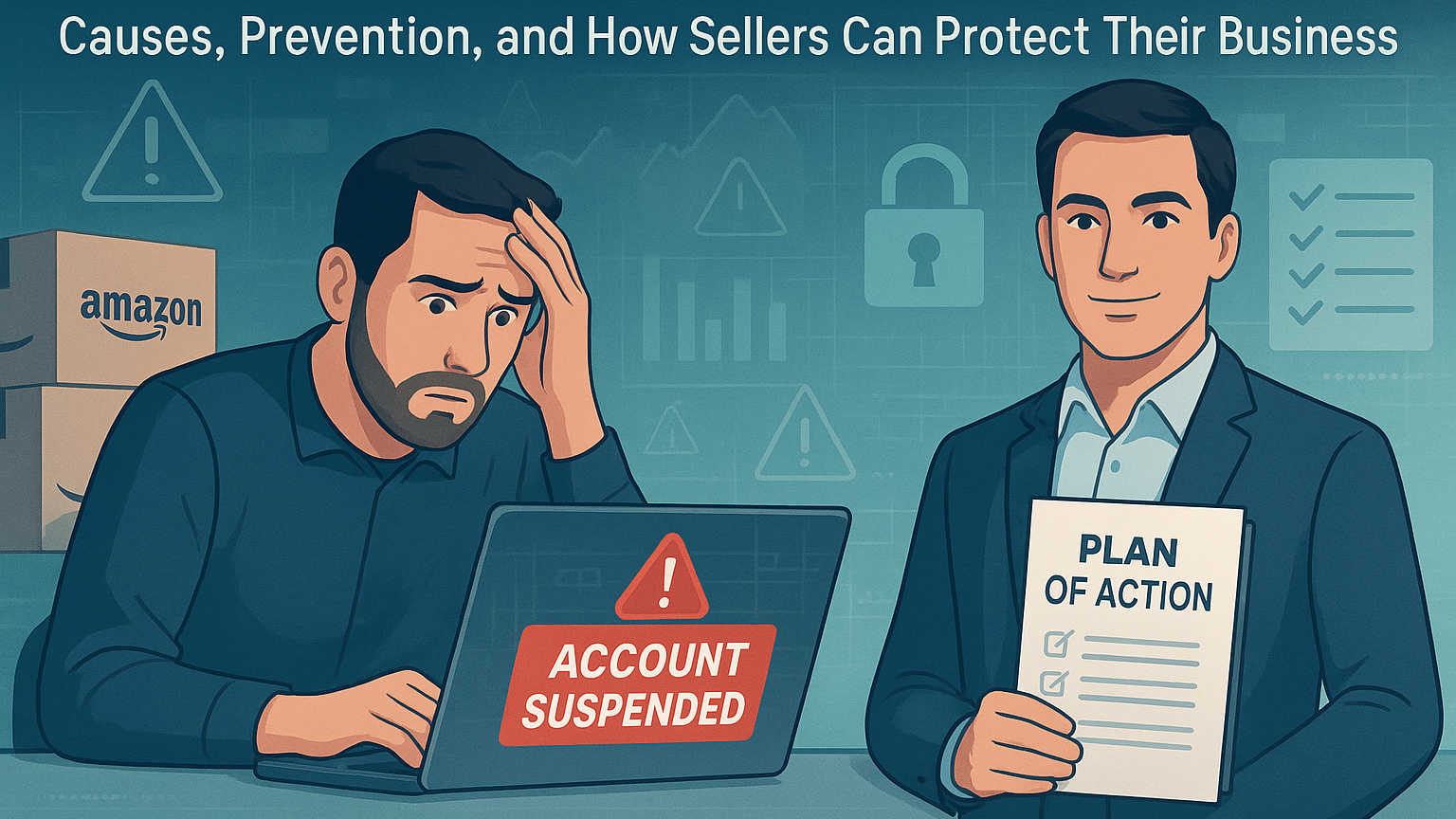
As an ethical funding partner to ecommerce sellers, VePay frequently hears the same urgent problem: long-running Amazon seller accounts, sometimes years of sales history, reviews, and hard-won Buy Box performance, suddenly get blocked by Amazon. When that happens, marketplaces freeze payouts, listings go dark, and sellers can lose access to their account history and inventory control. The result is not only immediate cashflow pain but long-term operational and reputational damage.
This article explains how and why Amazon blocks seller accounts, shows the typical ways suspensions happen, and gives an operationally practical roadmap to prevent (and respond to) suspensions. Where relevant we cite recent industry guidance and seller experiences so you can act from evidence and best practice.
What actually happens when Amazon blocks an account
When Amazon suspends or blocks a seller account, the typical platform actions include:
- Selling privileges removed — listings are suppressed or removed; no new orders.
- Payouts frozen or put into reserve — Amazon holds funds while investigating A-to-z claims, chargebacks, or alleged violations. Sellers often report funds held for months.
- Loss of access to Seller Central features — sellers may lose access to financial reports, advertising, and other tools after a period.
- Inventory at FBA can be stranded, disposed of, or subject to fees while the account is under review.
Because reinstatement requires Amazon’s approval (often via a Plan of Action), the fastest way to avoid catastrophic loss is prevention and good documentation before any issue arises.
The most common causes of account suspension (and why they matter)
Below are the typical root causes observed across industry reports and seller forums — each followed by the real operational risk it creates and a short prevention summary.
1. Poor seller performance metrics
What: High Order Defect Rate (ODR), excessive negative/neutral feedback, Late Shipment Rate, or high cancellation rates. Amazon uses thresholds — if these metrics spike, the algorithm flags the account.
Risk: Loss of Buy Box, suppressed listings, progressive remediation leading to suspension.
Prevention: Monitor metrics daily, set alerts for exceptions, use buffer stock or FBA to reduce late shipments, and automate cancellation/shipment handling.
2. Inauthentic / counterfeit complaints and IP issues
What: Buyer claims or rights-owner complaints that items are counterfeit, or intellectual property (trademark/copyright) violations. Amazon acts quickly on such reports.
Risk: Immediate listing takedown, funds holds, and possible permanent loss of account for repeated offenses.
Prevention: Source only from verified suppliers, keep invoices and supply-chain paperwork, enroll in Brand Registry or Transparency if you’re a brand, and maintain a two-year archive of invoices/relationships.
3. Listing accuracy / product condition problems
What: Product not as described, wrong condition (used as new), incorrect titles/specifications — causing buyer returns and claims.
Risk: Buyer claims / returns escalate metrics and lead to suspensions.
Prevention: Periodic listing audits, accurate variant mapping, quality control checks, and clear product images and descriptions.
4. Account integrity / identity verification failures
What: Amazon requires identity and tax/KYC documents. Copies that don’t match public records, suspicious multi-account links, or mismatched bank details trigger account integrity reviews.
Risk: Amazon may place account holds, request video verification, or suspend. Funds can be frozen while identity is validated.
Prevention: Maintain consistent company registration, bank and taxpayer records; ensure the account owner’s identity documents are current and correct; avoid overlapping personal/business details across multiple accounts.
5. Multiple or linked accounts and prohibited circumvention
What: Operating additional seller accounts without Amazon approval, or attempts to move restricted inventory between accounts after a suspension. Amazon tracks device/IP/payment linkages and flags “linked accounts”.
Risk: New accounts created to evade a suspension are often immediately banned and can lead to permanent prohibition.
Prevention: If you legitimately require a second account (e.g., separate legal entities), get prior written approval from Amazon and maintain fully distinct ownership, email, phone, bank, and device usage.
6. Policy violations (drop-shipping, review manipulation, pricing, restricted products)
What: Practices Amazon disallows—manipulating reviews, wrongly drop-shipping, selling restricted items, or pricing abuses. These are explicit policy triggers.
Risk: Fast escalations to account-level actions and potential legal exposure.
Prevention: Train staff on Amazon policies, run internal audits, and implement controls (e.g., ban sellers of restricted SKUs).
Preventive playbook. What every seller should do today
Operationalizing prevention is about systems and documentation. Here’s a practical checklist recommended:
- Daily monitoring & early warning
- Track ODR, return rate, late shipment rate, and A-to-z claims with dashboards. Trigger alerts if any metric trends up.
- Supplier & invoice governance
- Keep supplier contact details, invoices, Bills of Lading, and authorization letters for every SKU for at least 24 months. If Amazon asks for proof of authenticity, you must present it quickly.
- Centralized evidence vault
- Store photos, batch numbers, QC checklists, and supplier communications in a secure, searchable repository.
- KYC & corporate hygiene
- Ensure the legal entity, bank accounts, tax registrations, and Seller Central identity data match. Update documents proactively (IDs, passports, utility bills).
- Operational SOPs
- Standard operating procedures for returns, refunds, condition checks, listings edits, and complaint handling. Train customer-facing staff to de-escalate and to create case logs for every disputed order.
- Inventory strategy
- Keep a cash buffer and consider diversified inventory (some FBA for prime speed, some FBM for control). If you use third-party logistics, keep contracts and inbound/outbound manifests.
- Brand protection
- Register trademarks, apply for Amazon Brand Registry if eligible, and use protections like Transparency or Project Zero where possible. These programs reduce IP-related suspensions.
- Avoid banned behavior
- No review manipulation, no selling restricted goods, and no account linking to evade enforcement.
- Insurance & contingency planning
- Consider insurance for business interruption and maintain alternative sales channels (Shopify, other marketplaces) to reduce dependence on Amazon.
If you get suspended: immediate triage and a practical Plan of Action (POA)
If Amazon restricts your account, move fast and professionally: the goal is to produce a concise, evidence-based Plan of Action (POA) that shows you understand the root cause, fixed it, and put protections in place so it won’t reoccur.
Immediate steps
- Read Amazon’s suspension notice carefully — identify the exact policy or metric cited.
- Freeze risky operations — pause the SKU(s) or programs causing the issue to prevent further claims.
- Audit the affected orders — collect invoices, tracking, communications, photos, QC reports.
- Prepare your POA (see template below).
- Submit through Seller Central only — follow the exact submission route Amazon gave you.
Plan of Action: Concise structure that Amazon expects
A Plan of Action should be short, factual, and evidence-oriented. Use this three-part structure:
- Root Cause — 1–2 sentences. State what specifically caused the issue (e.g., “Supplier inconsistent labeling led to condition mismatches for ASIN X”). Don’t be vague.
- Corrective Actions Completed — bullet list of concrete fixes already implemented (e.g., “Removed suspect inventory, refunded affected customers, retrained fulfillment staff, updated listings with accurate UPCs”). Include dates and attachments.
- Preventive Plan (Systems) — explain new or reinforced processes to stop recurrence (e.g., “3-point supplier audit, mandatory 48-hour QC hold on inbound inventory, weekly performance reviews, invoice retention for 24 months, escalation matrix”). Include how you’ll monitor effectiveness.
Attach evidence: invoices, supplier LOAs, before/after screenshots, screenshots of corrected listings, training logs, policies, QC checklists, and a short timeline. The more relevant documentation, the better.
Example POA one-paragraph root cause + bulleted corrective and preventive actions is usually more effective than long, repetitive essays. Keep it professional and factual.
Why Amazon typically holds funds for, and what to expect
Amazon may place funds in reserve for reasons like outstanding A-to-z claims, pending investigations, or because of policy violations. Seller forum posts and experiences show that reserves can last weeks to many months depending on the case complexity. That’s why liquidity planning is critical.
Practical implication: Always maintain an operational cash buffer (3–6 months typical for high-risk sellers) and have contingency financing lines.
Operational checklist to reduce the chance of suspension.
- Daily performance dashboard with alerts (ODR, cancellation, late shipments)
- 24-month invoice & supplier document retention policy
- Centralized evidence vault and audit logs
- Formal supplier vetting (LOAs, distribution agreements)
- Clear listing SOPs and QC checkpoints for FBA inflows
- KYC & legal entity document sync (bank, tax, seller info)
- Incident response runbook and POA template ready to use
- Minimum cash buffer + alternative revenue channels (own website, other marketplaces)
- Enroll in Brand Registry / Transparency if eligible
Final practical tips & pitfalls to avoid
- Don’t create a shadow account as a “quick fix.” Amazon actively detects linked accounts; doing so risks permanent ban.
- Document everything proactively. The best reinstatements come from sellers who can immediately produce supplier invoices, photos, and process changes.
- If you need to appeal, be precise. A clear POA with measurable KPIs and evidence beats emotional or repetitive appeals.
- Diversify — the single most practical way to reduce platform risk is to sell across multiple channels and keep reserves or external liquidity options.
Amazon suspensions are a severe operational risk, but they’re largely avoidable with disciplined metrics monitoring, strong supplier documentation, robust KYC, and readiness to act fast if flagged. If a suspension occurs, a focused Plan of Action supported by verifiable evidence is the seller’s best path to reinstatement. From a financial resilience perspective, bridging liquidity solutions such as VePay’s ethical funding solution can be the difference between surviving a hold and having to close a business.